
 Over 30+ Years of Experience

You’ve decided on plantation shutters. You’ve picked your style, your colour, and your louvre size. Then you take a closer look at your windows and notice something that makes you pause — a window handle sitting right in the middle of the frame, a security lock that protrudes into the recess, a winding mechanism that sticks out further than expected, or a sill that isn’t level. Suddenly the straightforward installation you had in mind feels a lot more complicated.
Here’s the reassuring truth: window obstructions are far more common than most people realise, and they are almost never a reason to abandon your plantation shutter plans. With the right approach, the right configuration, and a bit of practical problem-solving, virtually every obstruction can be accommodated without compromising the look or function of your shutters. Here’s how to tackle the most common ones.
First, Identify the Type of Obstruction
Before you can solve the problem, you need to understand exactly what you’re dealing with. Window obstructions generally fall into a few categories — hardware obstructions like handles, locks, and winding mechanisms; structural obstructions like uneven sills, out-of-square frames, or protruding architraves; depth obstructions where the recess isn’t deep enough for the shutter and frame to sit properly; and fixed obstructions like security bars, fly screens, or existing fixtures that can’t be removed.
Each type requires a slightly different approach, and identifying which category your obstruction falls into is the essential first step before making any decisions about configuration or ordering.
Dealing with Window Handles and Locks
Window handles and locking mechanisms are probably the most frequently encountered obstruction in plantation shutter installations — and fortunately, they’re also among the easiest to work around. The most common solution is a cut-out — a precisely shaped opening in the shutter panel or frame that allows the handle or lock to pass through or be accessed without interfering with the shutter’s operation.
Cut-outs can be made in the shutter panel itself, in the frame, or in both, depending on where the hardware sits and how much clearance it needs. For handles that need to rotate or turn, the cut-out needs to be large enough to allow the full range of motion without the shutter panel obstructing the movement. For fixed locks or latches, a smaller, neater cut-out is usually sufficient.
When ordering your shutters, always note the position of any handles or locks — measured from the top of the window and from the nearest side — and communicate this to your supplier. Most quality suppliers will factor this into the panel design so the cut-out is precise, clean, and positioned correctly from the outset rather than being cut on-site after delivery.
Winding Mechanisms and Casement Stays
Casement windows — the type that open outward on a hinge — often have winding mechanisms or casement stays that sit within the window recess and need to be operated regularly. These can be trickier to accommodate than simple handles because they often sit low on the sill or at the side of the recess, right where a shutter frame would normally be positioned.
The most practical solution here depends on how often you need to operate the window. If you open the window regularly for ventilation, a split frame configuration — where the frame is interrupted at the point of the mechanism — or a direct jamb-hung panel without a full surrounding frame can give you the access you need. If the window is rarely opened, a cut-out in the panel may be sufficient.
In some cases, relocating the casement stay to a position that doesn’t conflict with the shutter frame is a worthwhile consideration — a small hardware change that makes the shutter installation significantly cleaner and more straightforward.
Shallow Window Recesses
A window recess that isn’t deep enough is one of the more challenging obstructions, but it’s still very manageable with the right approach. The depth issue typically arises when the recess is too shallow to accommodate both the shutter frame and the full range of louvre movement. As a general guide, louvre blades need a minimum of 55mm of clearance to open fully without hitting the sill — if your recess depth is less than this, you have a few options.
Choosing a narrower louvre size is the simplest solution. If you were planning on 89mm blades, dropping to 63mm blades significantly reduces the clearance required while still giving you a beautiful, fully functional shutter. The narrower blade has a slightly more traditional look that suits many home styles — and in a shallow recess situation, it’s often the most elegant solution available.
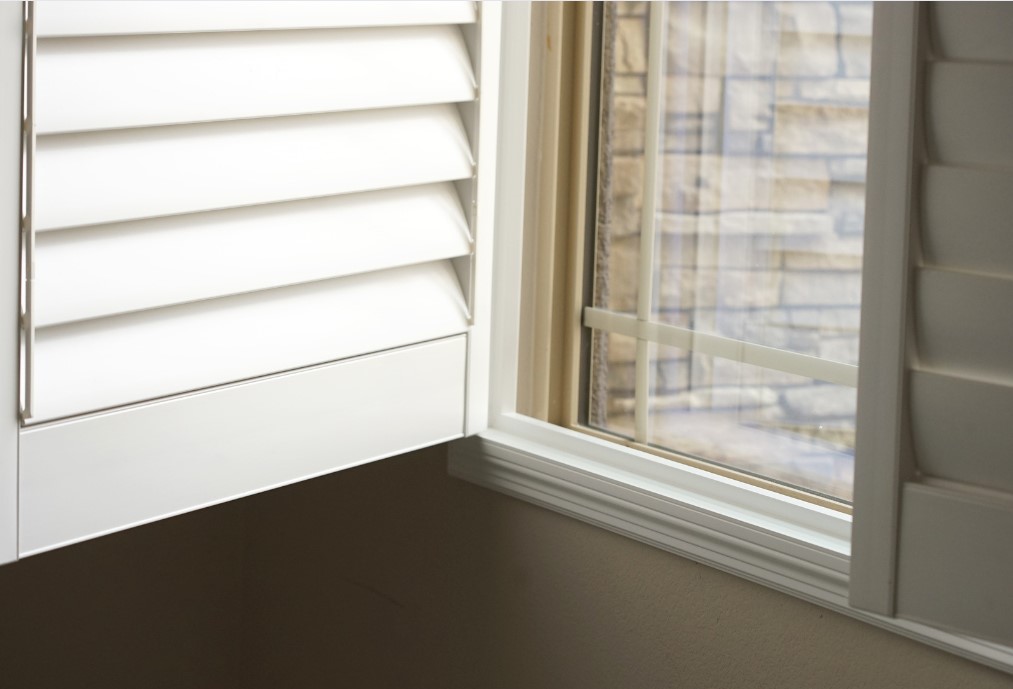
Alternatively, switching from an inside fit to a face fit configuration — where the shutter frame is mounted on the wall or architrave around the window rather than inside the recess — removes the depth constraint entirely. The trade-off is that the frame is more visible from the outside and the architraves may be partially covered, but for windows with very shallow recesses it can be the most practical path to a great result.
Uneven Sills and Out-of-Square Frames
Older homes in particular can have window frames that have shifted, settled, or simply weren’t perfectly square to begin with. An uneven sill or an out-of-square frame can cause problems with shutter alignment, gaps at the edges, and difficulty getting panels to sit flush.
The first step is to quantify the problem — measure the width and height of the window at multiple points and note any variation. A difference of just a few millimetres across the width of a window can cause noticeable alignment issues if not accounted for in the shutter dimensions.
For minor variations, ordering to the smallest measurement and using the frame to cover any gaps is often sufficient. For more significant out-of-square issues, packing shims behind the frame during installation can bring everything back into alignment. Your supplier’s installation guide will typically cover this scenario, and their support team can advise on the best approach for your specific measurements.
PVC plantation shutters are particularly well suited to installations with uneven frames because their dimensional stability means the panel itself won’t warp or shift over time in response to the imperfect surroundings. A PVC panel installed with minor shimming will continue to sit and operate correctly for years without the movement that timber panels can experience in response to moisture and temperature changes.
Security Bars and Fixed Fixtures
Security bars, fixed fly screens, and other permanent fixtures present a different kind of challenge — they can’t be worked around with a cut-out or a configuration change, and in most cases they can’t be removed. In these situations, the question becomes whether the shutters can be installed in front of or around the fixture, or whether the fixture needs to be temporarily removed for installation and then reattached.
For security bars on the outside of the window, inside fit shutters installed within the recess are generally unaffected — the bars are outside the frame and don’t interfere with the shutter at all. For internal security fixtures, the situation is more case-specific and worth discussing directly with your supplier before ordering.
Getting Expert Advice Before You Order
The single most effective thing you can do when you have an obstruction is to get expert advice before placing your order — not after. Most problems that become difficult or expensive to fix after delivery are completely manageable if identified at the planning stage. A good supplier will ask the right questions, guide you through the best configuration for your specific situation, and ensure your order is placed correctly the first time.
Before committing, it’s also well worth requesting a free sample so you can see the material quality and finish in your own home and confirm that your chosen colour and louvre size are right for the space. Seeing the product in person before ordering removes any uncertainty and ensures you’re completely confident in your choice.
For homeowners navigating more complex window situations, our practical guides, tips, and real-world inspiration cover a wide range of installation scenarios in clear, accessible detail — making it easier to understand your options and approach the project with confidence.
Warranty Coverage When Things Are More Complex
When an installation involves obstructions and custom configurations, having solid warranty coverage is more important than ever. A comprehensive warranty that covers the panel material, louvre mechanism, and hardware gives you the assurance that if anything does go wrong — whether it’s a manufacturing issue or a hardware failure — you’re protected. The best suppliers back their products with warranties of up to 25 years, which is the kind of long-term confidence that makes a complex installation feel like a sound investment rather than a risk.
A Solution Exists for Every Window
It’s worth stepping back and remembering the big picture — window obstructions are a normal part of installing shutters in real homes, and experienced suppliers have seen and solved every variation imaginable. Whether it’s a heritage home with character windows and original ironmongery, a modern apartment with security hardware and shallow recesses, or an older property with frames that have shifted over decades, a shutter solution exists for virtually every window — it just requires the right approach and the right guidance to get there.
The Bottom Line
Window obstructions are not a reason to give up on plantation shutters — they’re simply a problem to be solved. With the right configuration, the right material, and the right expert support behind you, virtually any obstruction can be accommodated without compromising the beauty or functionality of the finished result. The key is to identify the obstruction early, communicate it clearly to your supplier, and take advantage of the expertise available to you before you order.
Ready to get started on your plantation shutter project? Get a free quote today and let the experts help you find the perfect solution for your windows — obstructions and all.